

What Makes a Swap Wallet Worth Using
-
Multi-chain support. If you're hopping between Ethereum, Solana, BNB Chain, and others (and you will be), constantly switching apps is annoying at best and error-prone at worst. One wallet, all chains – seems like a better solution.
-
Liquidity routing. The wallet should be able to find competitive rates behind the scenes. If liquidity sources are limited, you’ll feel it in the final result.
-
Transparent fees. Gas fees are the part of the deal, but some wallets add their own swap fee on top without making it obvious. A decent wallet shows you the full cost before you confirm, not after.
-
Clear interface. Underrated, genuinely important. Confusing UX causes real mistakes. A clean interface is a risk reduction tool.
-
Security defaults. Private keys stay on your device, never transmitted. Transaction details are visible before you sign.
Which Type of Wallet Fits Your Flow
Non-custodial software wallet. Practical choice for regular swapping. You own your keys, you access any supported chain, trades settle without going through a third party. Hard to beat for day-to-day use.
Custodial wallet. Easier entry point, especially if you're just starting out. The tradeoff: you're limited to what the platform supports and you're playing by their rules. Fine for occasional use. Not ideal if you're swapping across networks regularly.
Hardware wallet. Great for protecting your long-term holdings. Not built for frequent swapping as the confirmation process is slow by design. Most people pair one with a software wallet: hardware for storage, software for active trading.
NOW Wallet: Built for People Who Actually Swap
NOW Wallet is built around simplicity; you swap directly inside the app. You keep full control of your private keys. And it doesn't make you choose between convenience and security.
What you get:
- Your private keys, fully in your hands
- 70+ blockchains from one interface
- Full transaction details before you confirm anything
- Built-in staking, dApp access, and Private Send when you need it
- Works on mobile and desktop
New to swapping? The flow is straightforward and doesn't throw 15 options at you at once. More experienced? The multi-chain coverage and features are actually there when you need them.
How to Swap Crypto in NOW Wallet
The mechanics are simple.
Step 1: Select your tokens
Start with the asset you already hold, then select what you want to receive.
Step 2: Select the network
Make sure the token and network match, especially if the asset exists on multiple chains.
Step 3: Review the rate and fees
Check the exchange rate, gas fee, and any swap fee. If slippage tolerance is adjustable, set it deliberately - too low and the swap fails, too high and you accept a worse rate than expected.
Step 4: Confirm
Look at everything once more and confirm. Your wallet signs and sends the transaction.
Step 5: Wait for confirmation
Most swaps land within seconds to a few minutes, depending on network congestion. A block explorer will show you exactly where things stand if you want to track it.
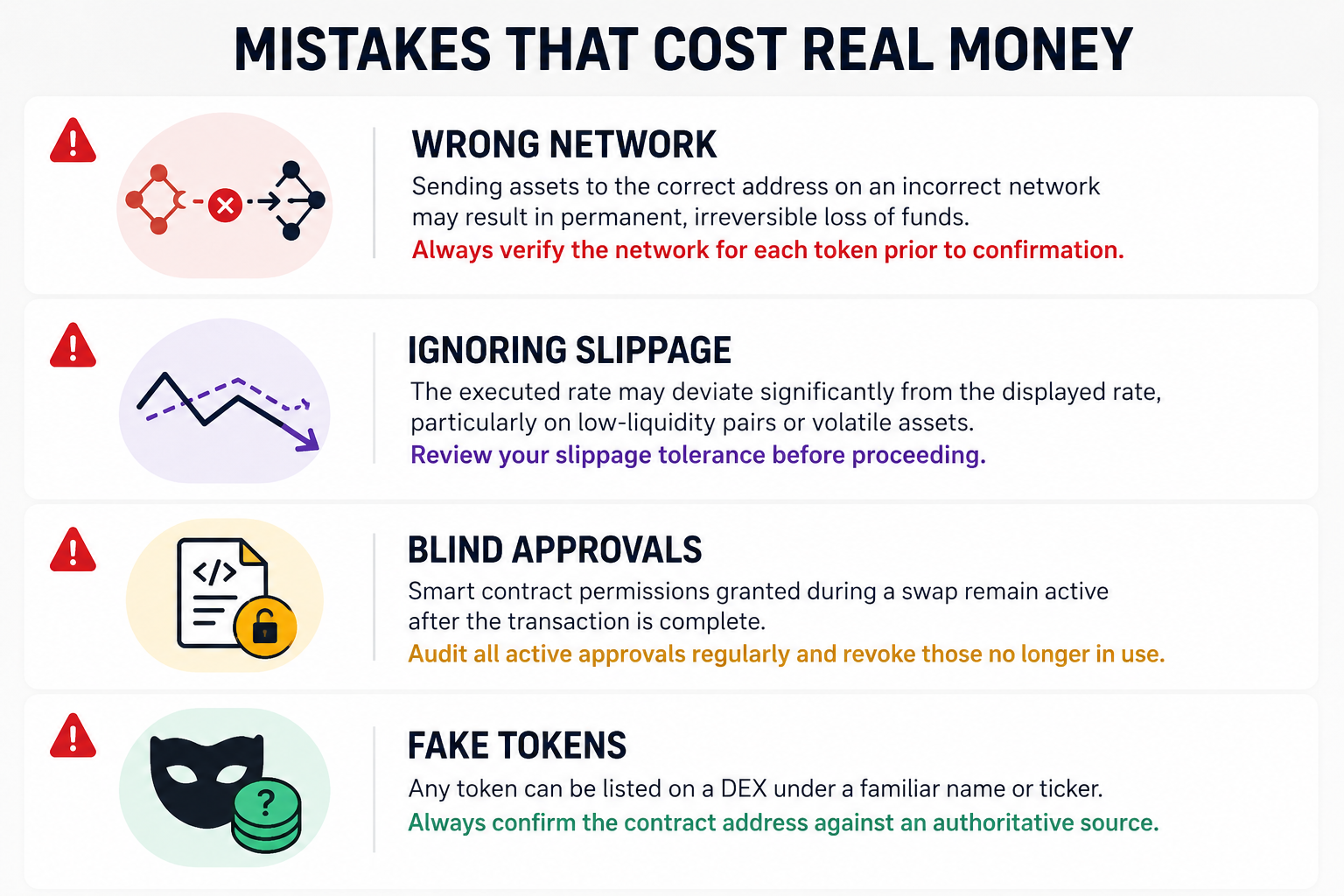
Mistakes That Cost Real Money
Four mistakes account for the majority of swap-related losses. Four mistakes account for the majority of swap-related losses.
Security: How to Swap Without Losing Funds
Recovery phrase = offline only. Never type it into a website. Never paste it anywhere. Never share it with "support." Write it down physically and put it somewhere you control.
Phishing gets better every year. Fake wallet sites, fake swap UIs, fake support DMs. The quality has gone up. Only use the official app or extension from the official source. If anything asks for your seed phrase, close it immediately. Read more about phishing in crypto in our previous article.
30-second contract check. For unfamiliar tokens or protocols, look up the contract address before you interact. People who did this have kept money they would otherwise have lost.
Audit your approvals. Contracts you approved six months ago might still have access to your tokens. Clean up anything you no longer need. Make it a regular habit.
Bottom Line
The best wallet to swap crypto is the one that fits how you actually use crypto. For regular swapping, the priorities are clear: multi-chain support, transparent fees, solid UX, and keeping your keys in your own hands.
Centralised exchanges still have their place for specific use cases.
But for day-to-day swapping across networks, a secure non-custodial wallet, like NOW Wallet, for example, removes the dependencies - no third party controlling access and no friction that isn't necessary.


