
$540 is not a random number. It’s the actual minimum investment on Prypco Mint - MENA's first government-backed tokenized real estate platform. Its first listing, a two-bedroom apartment in Business Bay, attracted 224 investors from 40+ nationalities and hit its funding goal in under 24 hours.
Each token represents a defined percentage of a property's value. A square meter gets divided into 10,000 tokens. You get rental income exposure and appreciation upside, but without the seven-figure wire transfer.
By 2033, tokenized assets are projected to represent 7% of Dubai's real estate market - around $16B. And that's a real structural shift.
Why Dubai & Why Now
Dubai doesn't experiment with things that don't scale. When the government backs a technology, it's because the strategy is already written - the pilot is just the last step before rollout.
Tokenized real estate is that step.
From Oil Economy to On-Chain Assets
The UAE has been running the same play since the 1970s: extract oil, build infrastructure, reinvest. It worked well enough to turn a desert coastline into the world's most visited city.
Now the playbook is changing. It’s not like oil stopped working, it’s just one revenue source is one point of failure.
Next read: Oil to On-Chain: Diversifying MENA’s Wealth with RWA Tokenization
UAE Vision 2030 is built around reducing oil dependency.
Blockchain isn't a side project in this picture: the Emirates Blockchain Strategy, launched in 2018, was designed to harness distributed ledger technology across government and economy.
Real estate tokenization is where that strategy stops being a whitepaper and starts generating transaction volume.
The timing isn't accidental. Dubai's property market was already booming - total sales hit AED 66.8 billion in May 2025 alone, a 44% year-on-year surge.
And tokenization channels existing demand toward a more accessible, more liquid market structure.
The $16B Ambition: Dubai's Real Estate Strategy 2033
In March 2025, DLD launched the pilot phase of its Real Estate Tokenization Project - the first property registration authority in the Middle East to implement blockchain-based tokenization of title deeds.
The target: 7% of Dubai's total real estate market by 2033, approximately $16 billion.
In May 2025 alone, $399 million worth of real estate was tokenized - roughly 1 in every 6 property deals in the city.
The infrastructure is live, the regulation is in place, institutional money is already moving: a $3 billion RWA agreement between MultiBank Group, MAG, and Mavryk closed the same month VARA updated its guidelines to formally include RWA tokenization provisions.
When government infrastructure, private capital, and regulatory clarity arrive at the same time - that’s a clear sign of market forming.
How Tokenized Real Estate Works in the UAE
From Title Deed to Token: The Step-by-Step
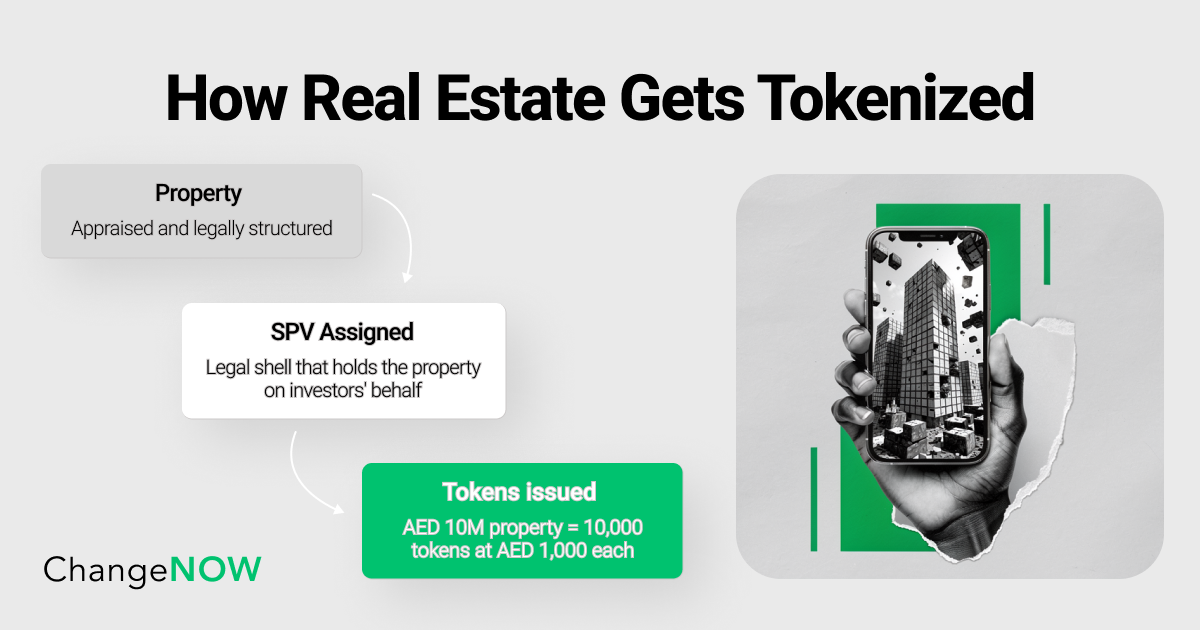
- A property gets appraised, legally structured, and assigned to an SPV (a Special Purpose Vehicle) that becomes the official owner on record.
- Investors don't buy the property. They buy shares of the SPV, represented as tokens on the blockchain.
- A property valued at AED 10 million gets divided into 10,000 tokens at AED 1,000 each.
- Each token carries proportional rights to rental income and asset appreciation.
Explore tokenized assets on ChangeNOW
Who Controls What: VARA, Central Bank, DLD and Their Roles
Three regulators, one system, and they actually talk to each other.
DLD owns the asset layer. Every token traces back to a verified title deed in the official registry. No token exists outside the legal property framework.
VARA owns the token layer. Running a tokenization platform in Dubai requires a Category 1 VASP licence and compliance with the Virtual Asset Issuance Rulebook, which created a specific category for real estate tokens called Asset-Referenced Virtual Assets, or ARVAs.
The Central Bank owns the money flow. AML, payments, economic integration: all transactions during the pilot phase run in UAE dirhams through licensed bank accounts.
Three layers, intentional overlap, redundancy by design. It's more bureaucracy than most crypto markets are used to. It's also why institutional capital is comfortable entering.
Dirhams, Not Crypto… For Now
The government-backed pilot runs exclusively in dirhams. No crypto accepted.
That's a deliberate choice: staying fiat means no Central Bank stablecoin licence required, cleaner legal footprint, faster launch.
The private market plays differently. By early 2025, around 3% of Dubai's off-plan transactions were already happening in crypto - predominantly among foreign investors drawn to faster, cheaper cross-border transfers.
DAMAC has been accepting Bitcoin and Ether since 2022. SmartCrowd, regulated by the UAE's SCA, allows investments from AED 500.
Two tracks running in parallel. One built for credibility and scale, one built for speed.
The longer-term solution is an AED stablecoin, and that infrastructure is actively being built - Zand Bank launched the UAE's first regulated multi-chain AED stablecoin in November 2025.
RAKBANK received approval in January 2026 to issue its own AED-backed token, explicitly designed for asset tokenization and cross-border settlements.
When one of these reaches critical adoption, 24/7 borderless settlement for tokenized real estate stops being a roadmap item.
Which brings the obvious question: what does that mean for investors who want in right now, before the infrastructure fully matures?
From Oil to Chain: The MENA Digital Assets Full Report
Dubai is the proof of concept. What comes next is the actual market built across the region.
We mapped the full picture in our deep-dive report From Oil to On-Chain: The Evolution of Technology, Crypto, and RWA Tokenization in the MENA Region.
You’ll get latest news and data on:
- The three scenarios for what happens next: War of Attrition, Systematic Collapse, Fragile Pause, and what each means for real estate investors specifically
- The regulatory landscape across the region: why UAE, Saudi Arabia, and Bahrain are playing three completely different games
- Structural risks on the path to maturity: what needs to happen before this market is ready for serious capital
- How Dubai's digital economy was actually built: from oil boom to blockchain infrastructure, the full historical arc
If you want to understand where this market is actually heading, it's in there.


